
Why Hair Transplants Fail
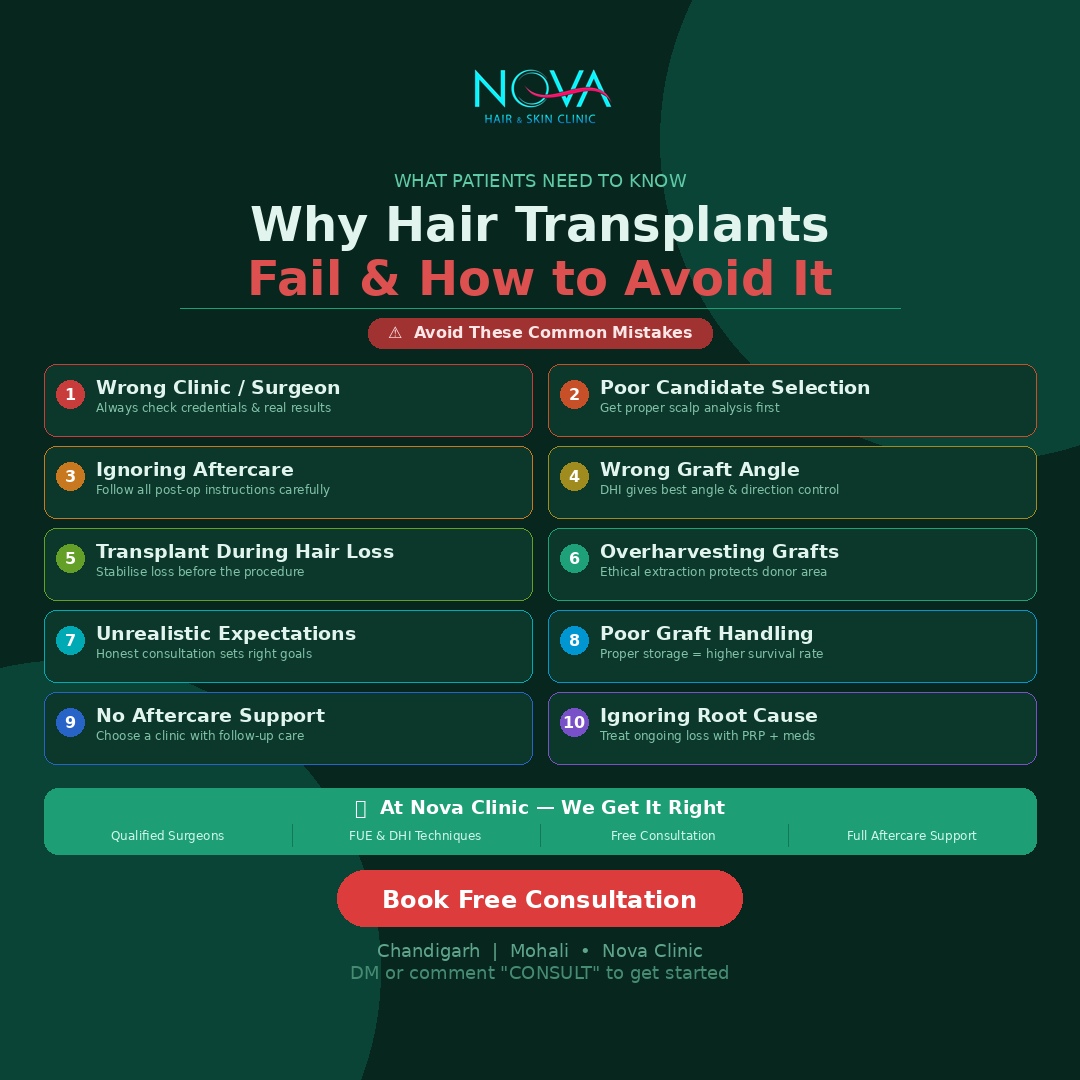
Why Hair Transplants Fail: 10 Common Mistakes to Avoid
A hair transplant is one of the most effective and permanent solutions for hair loss. But like any medical procedure, the results depend heavily on two things — the skill of the surgeon and the choices made by the patient.
If you have heard stories of failed hair transplants, unnatural results, or patchy growth, chances are one or more of these common mistakes were involved. At Nova Clinic, Chandigarh/Mohali, we believe an informed patient gets better results. Here are the 10 most common reasons hair transplants fail — and how to avoid them.
1. Choosing the Wrong Clinic or Surgeon
This is the number one reason hair transplants fail. Many patients choose a clinic based on low price alone, without checking the surgeon's qualifications, experience, or before-and-after results.
What to do instead:
- Always verify the surgeon's credentials and specialisation
- Ask to see real patient results — not stock photos
- Check Google reviews and patient testimonials
- Ensure the clinic uses modern FUE or DHI techniques
A hair transplant is a permanent procedure. Cutting corners on cost can lead to permanent damage.
2. Unrealistic Expectations
Some patients expect a full head of thick hair after a single session, regardless of their degree of baldness. When results do not match these expectations, the transplant is considered a "failure" — even when it technically succeeded.
What to do instead:
- Have an honest consultation about what is and is not achievable
- Understand that results depend on available donor hair, scalp condition, and the area to be covered
- Be aware that multiple sessions may sometimes be needed
3. Poor Candidate Selection
Not everyone is a suitable candidate for a hair transplant at every stage. Patients with insufficient donor hair, active medical conditions, or very advanced baldness may not get the results they expect.
What to do instead:
- Get a thorough hair and scalp analysis before proceeding
- Discuss your full medical history with the doctor
- A good clinic will tell you honestly if you are not yet a suitable candidate
4. Ignoring Aftercare Instructions
This is one of the most preventable causes of failure. After a transplant, the grafts are delicate and vulnerable for the first two weeks. Many patients scratch, touch, or expose their scalp to sun, sweat, or infection — causing graft loss.
Common aftercare mistakes:
- Touching or scratching the transplanted area
- Washing hair too aggressively in the first week
- Going to the gym or sweating heavily too soon
- Smoking or drinking alcohol in the recovery period
- Picking at scabs
5. Too Many Grafts Extracted in One Session
Some clinics overharvest grafts from the donor area to maximise results in a single session. This can permanently thin out the donor area and reduce the quality of future sessions.
What to do instead:
- Choose a clinic that follows ethical graft extraction limits
- Understand that spreading the procedure across sessions may give better long-term results
- The donor area is a lifetime resource — it must be managed carefully
6. Incorrect Angle and Direction of Implantation
Hair grows at specific angles and in specific directions on the scalp. If follicles are implanted at the wrong angle, the hair will grow in the wrong direction — creating an unnatural, "doll-hair" or "pluggy" appearance.
This is why technique matters so much. DHI (Direct Hair Implantation) gives surgeons the most control over angle and direction, making it ideal for achieving natural-looking results — especially for hairlines and beard transplants.
7. Transplanting During Active Hair Loss
If a patient is still in the active phase of hair loss (especially young patients in their early 20s), the non-transplanted hair around the grafts may continue to fall out — leaving the transplanted patches looking isolated and unnatural over time.
What to do instead:
- Stabilise hair loss before undergoing a transplant
- Use prescribed medications (Minoxidil, Finasteride) to slow loss before the procedure
- A good surgeon will advise you to wait if your hair loss is still progressing
8. Low-Quality Graft Handling
The time follicles spend outside the body (out-of-body time) and the conditions they are kept in directly affect their survival rate. Clinics that do not follow proper protocols for graft storage and handling will see lower survival rates.
What to look for:
- Clinics that keep grafts in proper preservation solution
- Minimise the time between extraction and implantation
- Handle grafts with precision tools — not rough handling
9. Not Addressing the Underlying Cause of Hair Loss
A hair transplant moves existing hair — it does not stop ongoing hair loss. If the underlying cause (such as DHT sensitivity, nutritional deficiency, or hormonal imbalance) is not addressed, the surrounding hair will continue to fall out, making the result look uneven over time.
What to do instead:
- Follow a post-transplant medication plan as recommended
- Consider PRP therapy to strengthen existing hair
- Get bloodwork done to rule out nutritional deficiencies
10. No Follow-Up Support
Some clinics operate on a "one and done" model — once the procedure is over, they provide no ongoing support. Patients are left confused about shock loss, slow growth, or unexpected results.
What Nova Clinic offers:
- Detailed post-procedure guidance
- Scheduled follow-up consultations
- PRP therapy support for enhanced results
- Direct access to our specialists throughout your recovery
How to Choose the Right Clinic — A Quick Checklist
Before booking your hair transplant, ask yourself:
- ✅ Is the surgeon qualified and experienced in FUE/DHI?
- ✅ Can I see real before-and-after results?
- ✅ Does the clinic offer a thorough consultation before the procedure?
- ✅ Will they explain realistic expectations honestly?
- ✅ Do they provide aftercare support and follow-ups?
- ✅ Is the pricing transparent with no hidden charges?
If the answer to all of these is yes — you are in the right hands.
Conclusion
A hair transplant does not fail on its own — it fails when the wrong decisions are made. By choosing the right clinic, following aftercare instructions, and having realistic expectations, the vast majority of hair transplants deliver excellent, lifelong results.
At Nova Clinic, Chandigarh/Mohali, we follow strict protocols at every step — from consultation and graft handling to implantation and aftercare — to give you the best possible outcome.
Book your free consultation today and take the first step the right way.
Disclaimer: Individual results may vary. This article is for informational purposes only. Please consult a qualified hair transplant specialist before making any medical decisions.