
How Many Grafts Do I Need
How Many Grafts Do I Need for a Hair Transplant? Complete Guide
One of the first questions people ask when considering a hair transplant is: "How many grafts will I need?"
It is a fair question — the number of grafts directly affects the cost, duration of the procedure, and the final result. But there is no one-size-fits-all answer. The right number depends on several personal factors that only a proper consultation can determine.
At Nova Clinic, Chandigarh/Mohali, we assess every patient individually before recommending a graft count. This guide will walk you through everything you need to understand about hair grafts — what they are, how many you might need, and what to realistically expect.
What Is a Hair Graft?
A hair graft is a small unit of tissue containing one or more hair follicles. When extracted from the donor area (usually the back or sides of the scalp), each graft typically contains:
- 1 hair — fine hairs used for soft hairline transitions
- 2 hairs — the most common unit
- 3–4 hairs — used for density in central areas
So 1,000 grafts does not mean 1,000 hairs — it could mean 2,000 to 3,500 hairs depending on the graft composition. This is why graft count alone does not tell the full story.
How Is the Graft Count Determined?
Your required graft count is calculated based on:
- The area to be covered — how large is the bald or thinning zone?
- The desired density — how thick do you want the final result to look?
- Your hair characteristics — coarser, curlier hair provides better coverage per graft
- Donor area availability — how many healthy grafts can safely be extracted?
- Your Norwood Scale stage — the internationally used scale to measure baldness
The Norwood Scale & Estimated Graft Count
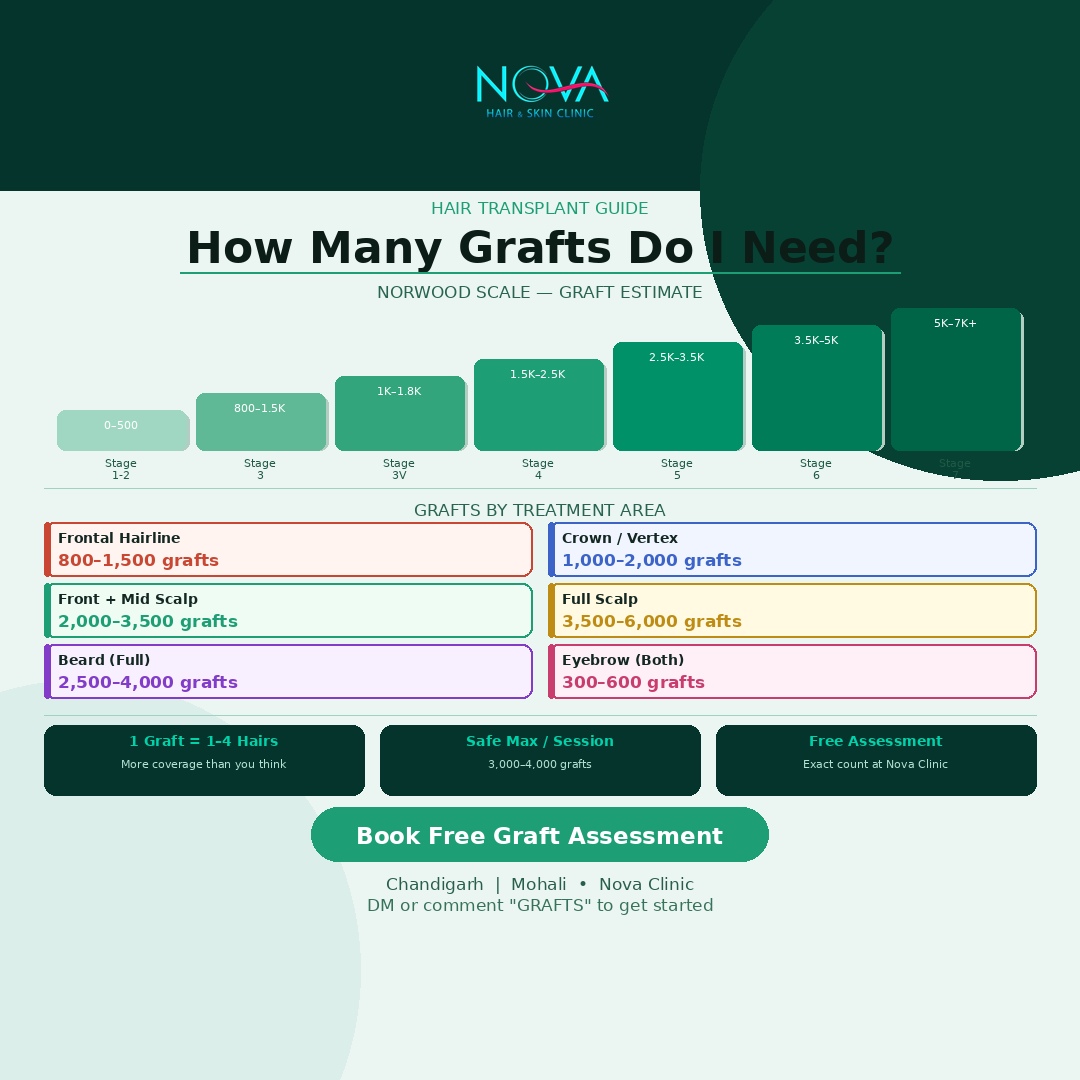
The Norwood Scale classifies male hair loss from Stage 1 (no loss) to Stage 7 (severe baldness). Here is a general guide:
| Norwood Stage | Description | Approximate Grafts Needed |
|---|---|---|
| Stage 1–2 | Minimal recession, no treatment needed | 0 – 500 |
| Stage 3 | Early frontal recession | 800 – 1,500 |
| Stage 3 Vertex | Crown thinning begins | 1,000 – 1,800 |
| Stage 4 | Moderate baldness, front + crown | 1,500 – 2,500 |
| Stage 5 | Significant baldness | 2,500 – 3,500 |
| Stage 6 | Extensive hair loss | 3,500 – 5,000 |
| Stage 7 | Severe baldness | 5,000 – 7,000+ |
Important: These are estimates. Your actual graft count is determined during your consultation at Nova Clinic.
Graft Requirements by Area
| Treatment Area | Approximate Grafts |
|---|---|
| Frontal hairline only | 800 – 1,500 |
| Crown (vertex) only | 1,000 – 2,000 |
| Frontal + mid scalp | 2,000 – 3,500 |
| Full scalp (front to crown) | 3,500 – 6,000 |
| Beard transplant (full) | 2,500 – 4,000 |
| Eyebrow transplant (both) | 300 – 600 |
| Moustache only | 400 – 700 |
What Determines Maximum Safe Extraction?
Not all available donor hair can be extracted in one session. The safe extraction limit depends on:
- Donor area density — how densely packed your existing hair is
- Scalp laxity — how flexible your scalp skin is
- Hair thickness and calibre
- Overall scalp health
Overharvesting grafts beyond the safe limit can permanently thin the donor area — a mistake some low-quality clinics make. At Nova Clinic, we always respect the donor area's lifetime capacity.
Single Session vs Multiple Sessions
| Single Session | Multiple Sessions | |
|---|---|---|
| Grafts | Up to 3,000–4,000 safely | 6,000+ over time |
| Best for | Mild to moderate baldness | Advanced baldness |
| Recovery | One recovery period | Recovery between sessions |
| Cost | One-time | Spread over time |
For patients with advanced hair loss (Norwood Stage 5–7), a staged approach with 2 or more sessions often gives better results than attempting everything in one sitting.
Will the Grafts Be Enough to Cover My Head?
This is where hair characteristics play a huge role. Factors that affect coverage per graft:
- Hair calibre (thickness) — thicker hair provides more visual coverage
- Hair colour vs scalp colour — high contrast (dark hair, light scalp) requires more grafts for the same appearance
- Hair texture — curly or wavy hair gives better coverage than straight hair
- Natural hair direction — aligned implantation maximises visual density
Our doctors at Nova Clinic take all of these into account when designing your personalised treatment plan.
What Happens if I Don't Have Enough Donor Hair?
In rare cases where scalp donor hair is insufficient, alternative donor sources can be considered:
- Body hair (chest, beard) — can supplement scalp donor hair
- PRP therapy — to thicken existing hair and reduce the area needing coverage
- Scalp Micropigmentation (SMP) — to create the illusion of density
Our team will discuss all available options during your consultation.
How to Get an Accurate Graft Count
The only accurate way to know your required graft count is through a professional consultation and scalp analysis. At Nova Clinic, our free consultation includes:
- Digital scalp analysis
- Norwood stage assessment
- Donor area evaluation
- Personalised treatment plan with estimated graft count and expected results
Conclusion
The number of grafts you need depends entirely on your unique hair loss pattern, scalp condition, and goals. Whether you need 800 or 4,000 grafts, the key is working with a team that assesses you properly, extracts grafts responsibly, and implants them with precision.
Book your free consultation at Nova Clinic, Chandigarh/Mohali and get an honest, personalised graft assessment from our experienced team.
Disclaimer: Graft estimates mentioned in this article are general guidelines. Actual requirements may vary based on individual assessment.