
8 Clear Signs You Need A Hair Transplant
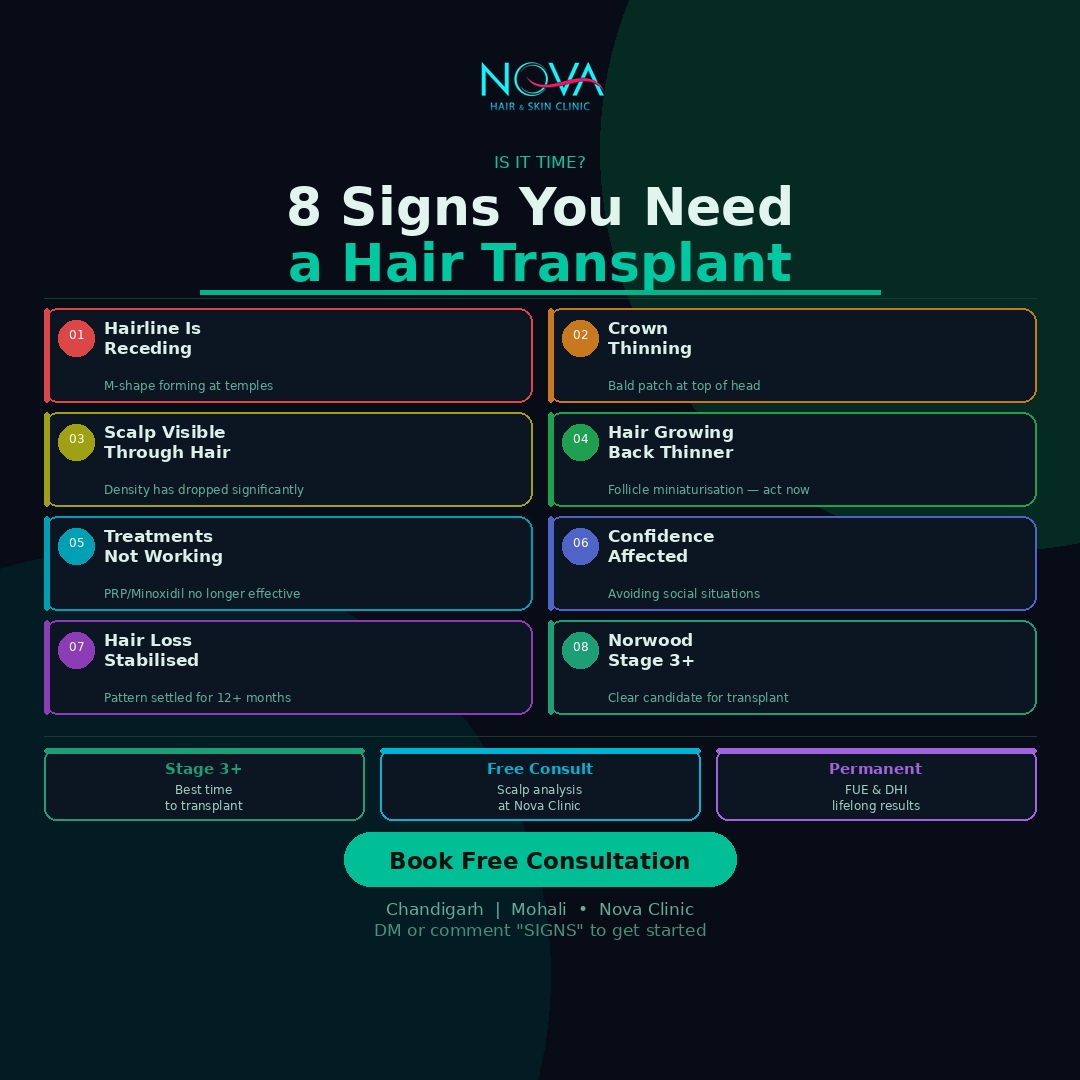
8 Clear Signs You Need a Hair Transplant (And What to Do Next)
Focus Keyword: signs you need a hair transplant Chandigarh
Hair loss is a gradual process — and most people wait far too long before taking action. By the time they seek treatment, the options available may be more limited than they would have been a few years earlier.
So how do you know when it is time to seriously consider a hair transplant in Chandigarh? This guide from the specialists at Nova Clinic, Chandigarh/Mohali outlines 8 clear signs that your hair loss has reached the point where a transplant is the right solution — and what to do next.
Why Timing Matters in Hair Transplant
A hair transplant works by relocating healthy, permanent hair follicles from your donor area (back of the scalp) to thinning or bald areas. The sooner you act, the more donor hair is available, and the better the final result.
Waiting too long can mean:
- More extensive baldness to cover with limited donor hair
- Fewer available grafts for a natural-looking result
- Reduced overall density achievable in a single session
The right time for a hair transplant is when your hair loss pattern has stabilised and the thinning is significant enough to affect your appearance and confidence — but not so advanced that donor hair is insufficient.
8 Signs It May Be Time for a Hair Transplant
Sign 1: Your Hairline Is Visibly Receding
A receding hairline — where the frontal hairline moves backward from the temples — is the earliest and most common sign of male pattern baldness. If you can see a clear "M-shape" forming at the top of your forehead, your hairline is already in the early stages of recession.
At this stage, a hair transplant can restore the hairline to a natural, age-appropriate position — delivering results that look completely authentic.
What to do: Book a hairline assessment at Nova Clinic. Our specialists will design the perfect hairline for your face shape.
Sign 2: Your Crown (Top of Head) Is Thinning
Thinning at the crown — also known as the vertex — is another classic sign of androgenic alopecia (pattern baldness). You may notice a circular or oval patch at the top of your head where the hair appears sparse or the scalp is visible.
Crown thinning can progress slowly, but once visible, it rarely reverses without treatment. A hair transplant to the crown area restores density and natural spiral growth patterns.
Sign 3: You Can See Your Scalp Through Your Hair
If bright light, wet hair, or certain angles reveal the scalp through thinning hair — your overall hair density has already reduced significantly. This is one of the clearest visual indicators that hair loss has progressed beyond early stage.
At this point, non-surgical treatments like Minoxidil or PRP alone may not restore the density you want. A hair transplant combined with PRP therapy often gives the best result.
Sign 4: Your Hair Is Not Growing Back the Same Way
After each hair cycle, hair naturally sheds and regrows. But in pattern baldness, each new hair grows back thinner, shorter, and finer than the previous one — a process called follicle miniaturisation caused by DHT.
Signs of miniaturisation:
- Hair feels thinner and more fragile than before
- Your hair does not grow as long as it used to
- Individual strands appear much finer at the root
- Hair breaks more easily
Once follicles are significantly miniaturised, they will not respond well to topical treatments. A hair transplant brings new, DHT-resistant follicles that grow permanently.
Sign 5: Non-Surgical Treatments Are No Longer Working
Many patients start with Minoxidil, PRP therapy, or nutritional supplements — and these work well in the early stages. But if you have been using these treatments consistently for 12–18 months and are still seeing continued hair loss or no meaningful regrowth, it is a strong sign that your follicles are too weakened to respond to non-surgical stimulation alone.
A hair transplant is the next logical step — and existing treatments like PRP can still be used post-transplant to strengthen surrounding hair.
Sign 6: Hair Loss Is Affecting Your Confidence and Daily Life
Hair loss is not just a cosmetic concern — it has a very real psychological impact. Studies consistently show that hair loss affects:
- Self-confidence and self-image
- Social interactions and relationships
- Career confidence and professional presentation
- Mental health — with links to anxiety and depression
If you find yourself avoiding social situations, adjusting your hairstyle constantly to hide thinning areas, or feeling distressed about your appearance — this is a valid reason to explore a permanent solution. You deserve to feel confident in your appearance.
Sign 7: Your Hair Loss Pattern Has Stabilised
This is a crucial factor for hair transplant suitability. Performing a transplant while hair loss is still actively progressing can result in the transplanted hair sitting in isolation as surrounding native hair continues to fall.
Signs your hair loss has stabilised:
- No significant change in your hairline or crown over the past 12 months
- Hair fall has reduced to normal levels (under 100 hairs per day)
- You are in your late 20s or older (hair loss in men under 25 is often still progressing)
If your pattern has stabilised, you are likely a good candidate for a hair transplant. Our specialists at Nova Clinic confirm this through a detailed scalp and hair loss assessment.
Sign 8: You Are Norwood Stage 3 or Above
The Norwood Scale is the internationally recognised classification system for male pattern baldness, ranging from Stage 1 (no visible loss) to Stage 7 (extensive baldness). Hair transplants become a strong recommendation from Stage 3 onwards:
| Norwood Stage | Description | Transplant Recommended? |
|---|---|---|
| Stage 1–2 | Minimal recession | Non-surgical first |
| Stage 3 | Clear frontal recession | Yes — ideal timing |
| Stage 4 | Significant front + crown loss | Yes — strong candidate |
| Stage 5–6 | Extensive baldness | Yes — may need 2 sessions |
| Stage 7 | Severe baldness | Possible with donor assessment |
What Happens at Your Free Consultation at Nova Clinic?
If you recognise 3 or more of these signs in yourself, it is time to book a consultation. At Nova Clinic, Chandigarh/Mohali, your free consultation includes:
✅ Digital scalp analysis — assesses follicle density and donor area ✅ Norwood stage assessment — determines your hair loss pattern and progression ✅ Graft count estimation — how many grafts you need for your goals ✅ Technique recommendation — FUE or DHI based on your specific case ✅ Personalised treatment timeline — when to proceed and what results to expect ✅ Cost transparency — clear, honest pricing with no hidden charges
FUE vs DHI — Which One Is Right for You?
At Nova Clinic, we perform two advanced hair transplant techniques:
FUE (Follicular Unit Extraction): Individual follicles are extracted one by one from the donor area and implanted into the recipient area. Ideal for larger areas with minimal scarring.
DHI (Direct Hair Implantation): Follicles are implanted directly using a Choi pen, giving the surgeon precise control over angle, direction, and depth. Ideal for hairline design and high-density results.
Our specialists recommend the right technique based on your specific hair loss pattern, donor area, and desired results.
Frequently Asked Questions (FAQs)
At what age should I get a hair transplant?
Most specialists recommend waiting until at least 25–28 years of age, when the hair loss pattern has stabilised. Younger patients are usually advised to start with non-surgical treatments first.
Is a hair transplant permanent?
Yes. Transplanted follicles are DHT-resistant and grow permanently for life. They can be cut, coloured, and styled just like natural hair.
How long does it take to see results after a hair transplant?
New growth begins at 3–4 months. Full, natural results are visible by 10–12 months post-procedure.
Does a hair transplant hurt?
The procedure is performed under local anaesthesia. Most patients experience minimal discomfort during and after the procedure.
How do I know if I have enough donor hair?
Our team at Nova Clinic assesses your donor area density during your free consultation to determine the maximum safe graft count available.
Can I get a hair transplant if I am at Norwood Stage 6 or 7?
Yes, though advanced stages may require multiple sessions or creative donor area management. Our specialists will give you an honest assessment of what is achievable.
Conclusion
Recognising the signs early and acting at the right time gives you the best possible hair transplant outcome. Whether you are noticing a receding hairline, crown thinning, or have simply lost confidence in your appearance — Nova Clinic, Chandigarh/Mohali is here to guide you through every step.
Book your free consultation today and find out if a hair transplant is the right solution for you.
📞 Book Free Consultation ⭐ Leave Us a Google Review
Disclaimer: This article is for informational purposes only. Individual suitability for hair transplant varies. Please consult a qualified specialist for a personalised assessment.